Aid and Relief Logistics in Nepal: Moving Critical Cargo When It Matters Most
When aid delays, it costs more than time. Here's how Brisk Forwarding moves relief cargo through customs, warehousing, and last-mile delivery across Nepal.
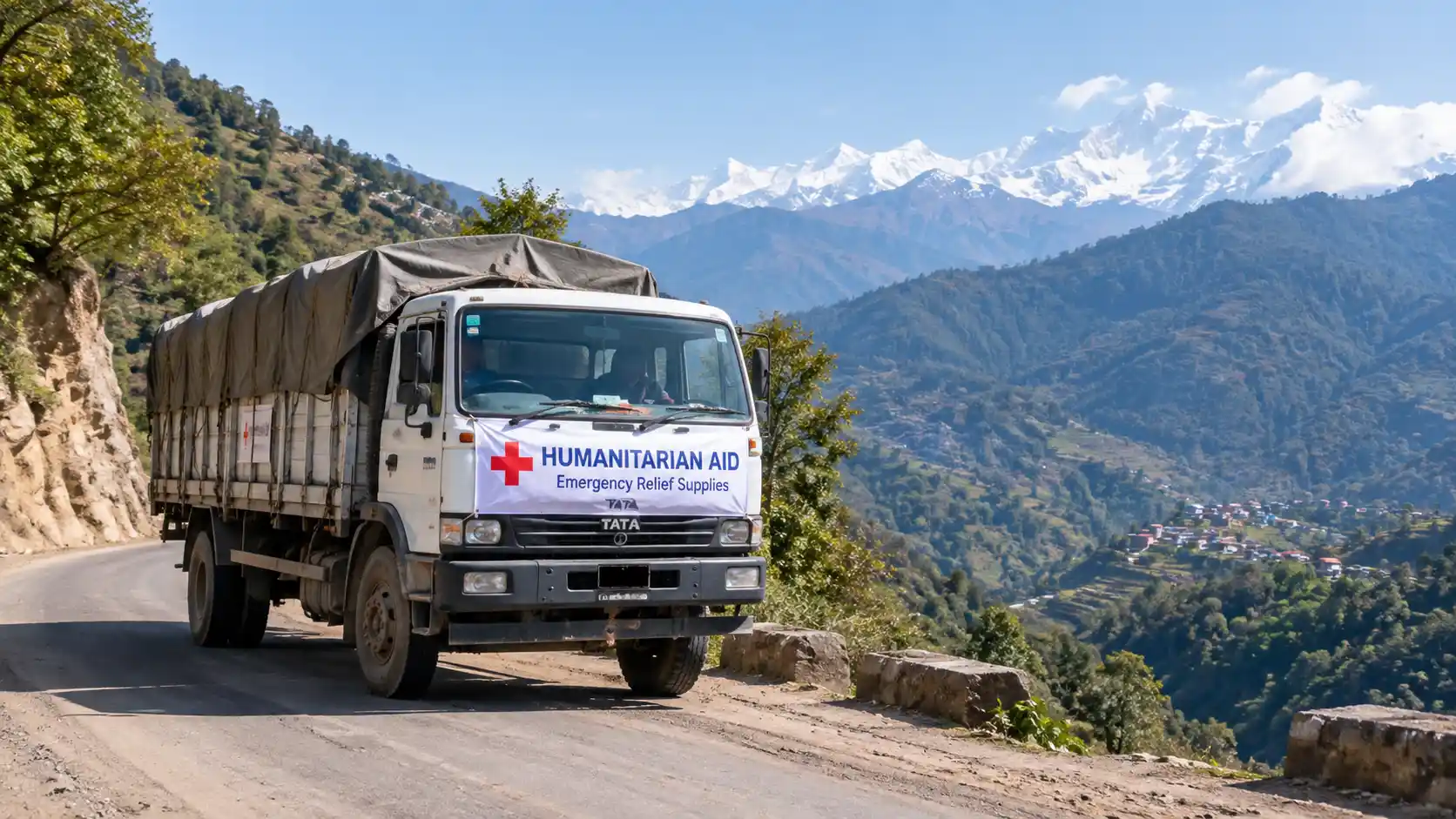
Nepal doesn’t get much warning before it needs help. That is exactly why aid and relief logistics in Nepal matters so much. A 7.8 magnitude earthquake in 2015 proved that in the most painful way possible: the difference between aid that arrives and aid that sits on a tarmac often comes down to logistics, not intentions.
If you work in humanitarian response, procurement, or NGO operations, you already know this. Getting tents, water filters, and medical supplies donated is the easy part. Getting them through customs, off a runway, and into a district that landslides just cut off from the road network is where most relief efforts actually face their real test.
This is what aid and relief logistics in Nepal means in practice, and it’s a category Brisk Forwarding takes seriously, not as a side service, but as one of the few areas of freight forwarding where a delay genuinely costs lives rather than money.
What Counts as Aid and Relief Logistics Cargo in Nepal
Aid and relief logistics in Nepal covers the movementof goods intended for emergency response, disaster recovery, and ongoing humanitarian programs. In Nepal, that typically includes:
- Emergency shelter materials such as tents, tarpaulins, and blankets
- Water, sanitation, and hygiene (WASH) supplies including water filters and purification kits
- Medical and pharmaceutical shipments for field clinics and hospitals
- Food aid and nutrition supplies
- Non-food relief items like solar lanterns, cooking sets, and hygiene kits
- Equipment for NGOs and UN agencies operating long-term development programs, not just crisis response
The common thread isn’t the product category. It’s the urgency and the accountability. A commercial shipment that arrives three days late is an inconvenience. A relief shipment that arrives three days late during monsoon season can mean a district goes without shelter through a week of rain.
Why Aid and Relief Logistics in Nepal Demands Specialized Skills
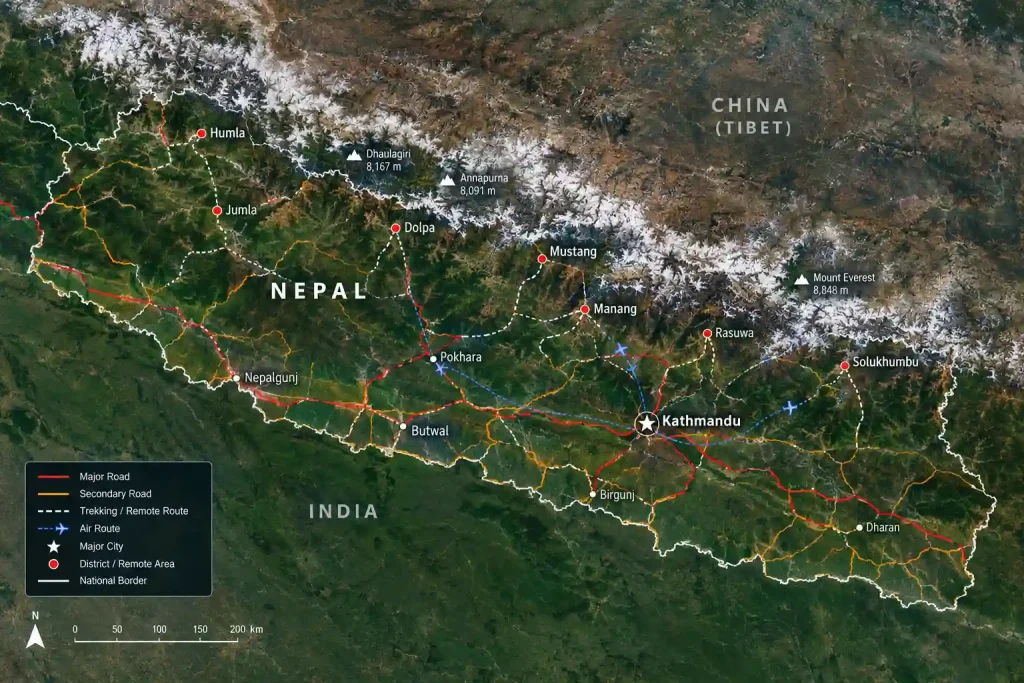
Ask any freight forwarder if they can move humanitarian cargo, and most will say yes. Ask them if they’ve actually coordinated a shipment into a district reachable only by mule track after a landslide, and the answers get a lot shorter.
Nepal is landlocked. Almost everything arrives by air into Tribhuvan International Airport, or overland through Indian ports like Kolkata and Vizag before crossing the border at points such as Birgunj. That already adds a layer of cross-border customs coordination that flat, coastal countries don’t deal with. Add the terrain: eight of the world’s fourteen highest peaks, monsoon-triggered landslides every year, and a road network that narrows to single-lane mountain tracks outside the Kathmandu Valley. The result is a supply chain where the last fifty kilometers are frequently harder than the first five thousand.
What Nepal’s 2015 Earthquake Relief Logistics Response Actually Looked Like
The scale of the 2015 response is worth understanding, because it’s the clearest data point Nepal has on what humanitarian logistics under pressure requires. Within the first week, the World Food Programme, as lead agency of the Logistics Cluster, had handled over 2,000 cubic meters of humanitarian cargo. This served around 30 organizations at the Humanitarian Staging Area next to Kathmandu’s airport. That volume kept climbing. By mid-May, the Logistics Cluster had handled 1,700 metric tons of relief cargo for 45 different organizations. Daily cargo flow through the staging area had risen to around 150 metric tons.
Moving Cargo From Kathmandu to the Districts
Getting that cargo out of Kathmandu and into the affected districts required a dedicated trucking operation. WFP contracted a fleet of 25 trucks, each with roughly 15 metric ton capacity. These trucks moved shelter, food, health, and WASH items into Nuwakot, Dhading, Gorkha, Rasuwa, Kavre, Sindhupalchok, and Dolakha. Where trucks couldn’t go, the response leaned on air transport and, in the most remote pockets, traditional porters. The government and its partners combined trucks and helicopters with traditional Nepalese carrying methods to reach areas that landslides had isolated ahead of the monsoon season.
By the time the operation wound down, UNHAS alone had moved close to 2,300 metric tons of humanitarian cargo. It also carried nearly 3,400 relief workers into hard-to-reach parts of the country between late April and early November.
That’s the scale of coordination a genuine emergency demands. Hundreds of organizations, multiple transport modes, and a supply chain rebuilt daily around whichever roads happened to still be open. Most freight forwarders will never touch a shipment at that scale. But the same coordination skills apply, just compressed, to a single NGO moving a container of medical supplies into a mid-hill district today.
For detailed operational data and coordination strategies from the 2015 response, visit the Logistics Cluster’s official Nepal earthquake response documentation. It provides real-world insights for current and future humanitarian operations.
The Real Bottlenecks Slowing Aid and Relief Logistics in Nepal
If you’re planning a shipment, these are the points that actually cause delays, based on how cargo moves through Nepal in practice.
1) Customs Clearance for Donated and Duty-Exempt Goods
Relief shipments often qualify for duty exemptions, but you have to file that paperwork correctly and in advance, or the shipment sits at the airport or border while officials sort out the exemption. This is one of the highest-value things a good forwarder does: knowing the exemption process cold, rather than discovering it mid-shipment.
2) Airport Capacity
Tribhuvan International Airport is Nepal’s only major international gateway, and it becomes a genuine bottleneck during large-scale emergencies when aircraft slots, apron space, and ground handling all stretch to their limit at once.
3) Overland Transshipment Through India
Sea freight bound for Nepal lands at an Indian port and has to cross the land border, and that leg alone typically adds roughly a week to transit time, so building it into the timeline from day one matters.
4) Last-Mile Access Outside the Kathmandu Valley
Roads into the mid-hills and mountain districts are seasonal at best. Monsoon landslides, winter snow at altitude, and simple road quality mean the last leg of a delivery often needs a different vehicle, a different route, or a local porter network entirely.
5) Temporary Storage
Relief cargo frequently arrives faster than it can be distributed, so having pre-arranged warehousing near the airport, rather than scrambling for it after cargo lands, is what keeps goods from sitting exposed or getting damaged.
How Brisk Forwarding Delivers Aid and Relief Logistics in Nepal
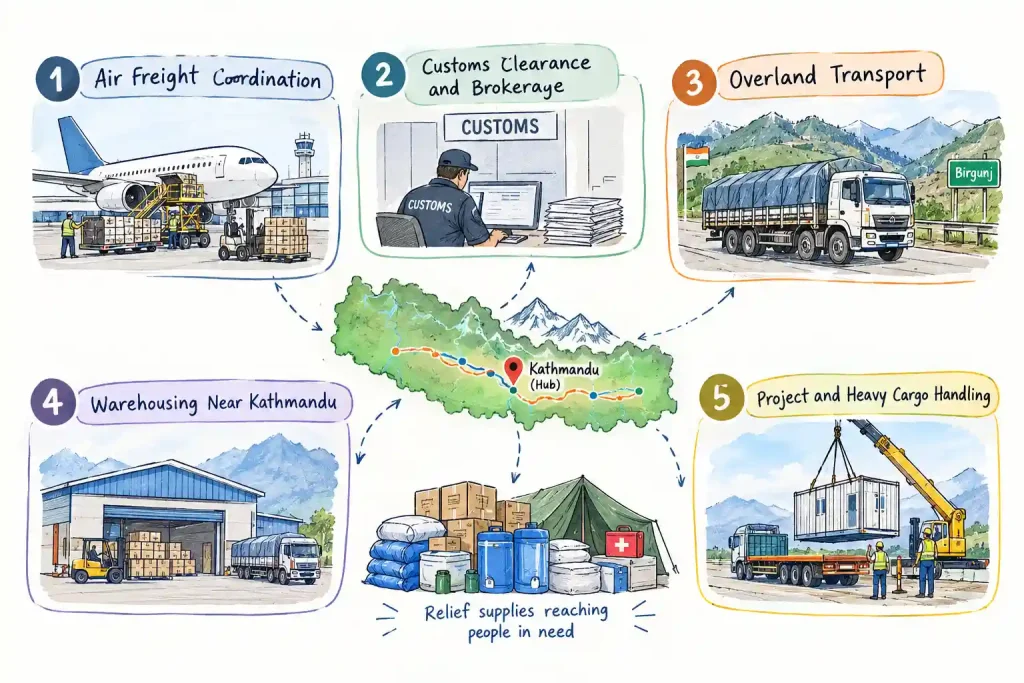
We built our process around the bottlenecks above, not around a generic freight checklist.
1) Air Freight Coordination
Air freight coordination for time-critical shipments landing at Tribhuvan International Airport, including slot and ground-handling coordination during high-traffic periods. See our air freight forwarding services for the full scope.
2) Customs Clearance and Brokerage
Customs clearance and brokerage with specific experience in duty-exempt and donated goods documentation, so paperwork is filed correctly before cargo arrives rather than after. More detail is on our customs clearance and brokerage page.
3) Overland Transport
Overland transport for cargo transshipping through Indian ports and crossing at Birgunj, with realistic transit timelines built in from the quote stage. Covered under our land and overland transport services.
4) Warehousing Near Kathmandu
Warehousing near Kathmandu for staging relief goods before onward distribution, so cargo has somewhere secure to sit if the last-mile leg is delayed by weather or road conditions. Details on our warehousing and distribution page.
5) Project and Heavy Cargo Handling
Project and heavy cargo handling for larger shipments such as prefabricated shelters, water treatment units, or medical equipment that need specialized handling. See project cargo and heavy lift services.
Who Uses Aid and Relief Logistics in Nepal
This isn’t only for crisis response. Nepal has a large and steady NGO and INGO presence running long-term programs in health, education, water access, and rural development. Their supply chains face the same terrain and customs realities on every single shipment, not just during a declared emergency. Our aid and relief clients typically include:
- International NGOs and development agencies with ongoing program logistics
- UN agencies and their implementing partners
- The Nepal Red Cross Society and affiliated disaster response organizations
- Government disaster management bodies coordinating with private-sector logistics
- Medical and pharmaceutical donors shipping equipment for clinics and field hospitals
What to Look for in an Aid and Relief Logistics Partner in Nepal
If you’re evaluating forwarders for humanitarian cargo into Nepal, ask these questions before you sign anything:
1) Do They Have Documented Duty-Exemption Experience?
Do they have documented experience with duty-exemption paperwork, or will they be learning it on your shipment?
2) Can They Name Specific Routes and Districts?
Can they name specific districts and routes they’ve moved cargo into outside the Kathmandu Valley?
3) Do They Have Pre-Arranged Warehousing?
Do they have pre-arranged warehousing, or will storage be improvised after cargo lands?
4) What’s Their India Transshipment Timeline?
What’s their actual transit time estimate for the India transshipment leg, not the best-case number?
5) Who Handles the Last-Mile Leg?
Who do they coordinate with on the ground for the last-mile leg when roads are seasonal or damaged?
A forwarder who can answer all five specifically, rather than in general terms, is one who has actually done this work.
Frequently Asked Questions About Aid and Relief Logistics in Nepal
How Long Does Aid and Relief Logistics in Nepal Take?
Air freight through Tribhuvan International Airport typically clears within a few days once customs and exemption paperwork are in order. Sea freight through Indian ports adds transshipment and border-crossing time on top of ocean transit. Plan for longer door-to-door timelines in advance rather than assuming the best case.
Does Aid and Relief Logistics in Nepal Qualify for Customs Duty Exemptions?
Many donated and humanitarian goods can qualify, but you have to apply for the exemption with the correct documentation before or at the point of import. This is one of the most common causes of delay when someone without direct experience in the process handles it.
What Happens When Roads to a District Are Blocked by Landslides?
Forwarders typically reroute cargo through alternate roads, move it by air where a landing strip exists, or, in the most remote cases, hand the final stretch to porters. That’s exactly how the 2015 earthquake response reached its most isolated districts.
Can a Freight Forwarder Handle Both the International Shipment and the Last-Mile Delivery?
Yes, and this is worth insisting on. A forwarder who only manages the shipment to Kathmandu and hands off responsibility at the airport leaves the hardest leg without clear ownership. That’s the last-mile delivery, and it’s the most failure-prone part of the journey.
Ready to Get Started?
Contact our logistics specialists today for customized solutions, route information, and a quick quotation.