Full Truck Load vs Part Truck Load: Which One Fits Your Business?
Let’s imagine you have your goods ready in your warehouse to be delivered. Have you decided to go with a full truck or a part truck? Choosing between full truck...
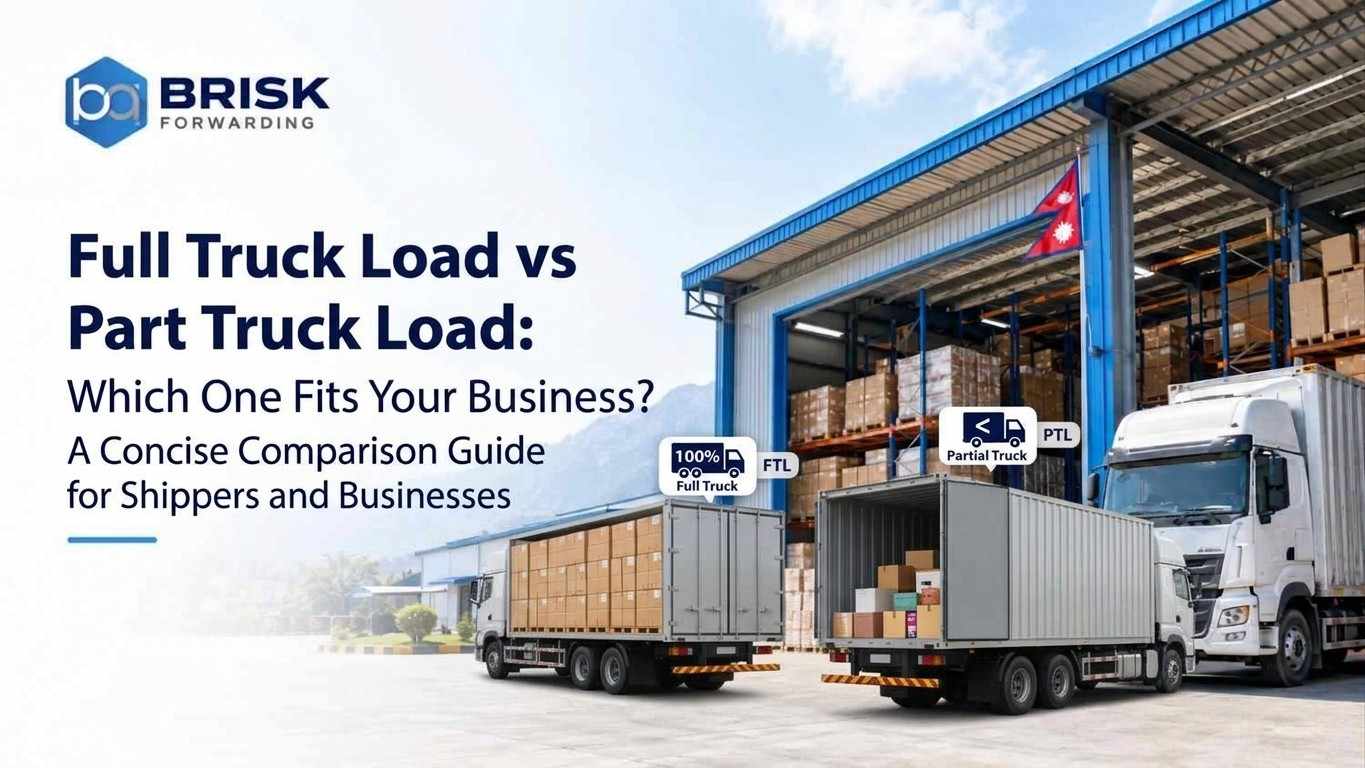
Let’s imagine you have your goods ready in your warehouse to be delivered. Have you decided to go with a full truck or a part truck?
Choosing between full truck load vs part truck load options will impact how quickly your goods will arrive, how safe they’ll be and how smooth your supply chain will run. Choosing the right one will mean you’re spending less on freight costs. Choosing the wrong option can increase your transportation costs by leaving truck space unused or cause delivery delays due to additional stops and handling.
This guide will break down the options for FTL vs PTL in simple terms to show who they’re best for. We’ll then provide a comparison and give you a simple method to decide which option is best for your next shipment in Nepal.
Quick Answer: Full Truck Load vs Part Truck Load
Full truck load occurs when one customer books an entire truck. This means your goods will go straight from the pickup to the delivery with no other customers’ goods.
Part truck load means you’re sharing the truck with other customers. You’ll only pay for the amount of space/weight used. The truck may make additional stops.
Choose full truck load for large amounts of goods, urgent deliveries, fragile or high-value goods. Choose part truck load for smaller, regular shipments that are cost sensitive.
What Is Full Truck Load (FTL)?
Full truck load means the entire vehicle will be used for your goods. The truck will come to your warehouse/factory/border point and will be loaded once and driven straight to the destination with no other goods in the truck.
This is similar to booking a taxi rather than a shared minibus. You can decide when to load your goods in.
A full truck load makes sense if you’re transporting a large amount of goods (by weight or volume), so it’s worth it to book an entire truck. This is common in Nepal for importing goods from the border/dry port to your warehouse, transporting goods from your factory to distributors and transporting construction materials/machinery.
Why FTL Matters for Business Logistics?
- Fast: The truck will go from A to B with no stops for other customers. This will reduce your delivery time and make it easier to guarantee delivery times.
- Safer: Your goods are loaded once and won’t be touched until they arrive. This will reduce damage and cross-contamination.
- Cheaper per unit: You’re paying for the truck, so if it’s filled up well, you’ll save money per pallet or kg.
- Easy to track: You know exactly where your shipment is as there’s only one truck, one route and one delivery.
Which Industries Should Choose FTL?
- Manufacturing companies: Factories will often have enough goods to fill a truck with raw materials or finished goods.
- Retail/FMCG Distributors: You’ll have quicker and more predictable deliveries to your warehouse or lots of stores.
- E-commerce Warehouses: If you’re transporting a large amount of goods between your fulfillment centres/warehouses, it makes sense to use a full truck.
- Construction: Heavy and bulky goods such as cement, steel, tiles and piping will fill up a truck quickly.
- Food and Drink companies: Perishable goods can’t afford to be delayed or handled multiple times.
- Pharma and Healthcare: Sensitive goods will benefit from fewer stops.
- Importers: Most businesses will require a full truck to collect their full consignment from a border point/dry port.
What Is Part Truck Load (PTL)?
Part truck load means you’re sharing the truck. Your goods will take up some of the truck and other businesses will have their goods transported with you. Everyone will pay for the amount of space/weight they use.
Similar to carpooling. You’re getting professional transport but only paying for the amount of space you need.
However, you won’t have as much control. The truck will usually leave when there’s enough goods to go. It may make additional stops to load/unload other customers.
Why PTL Makes Business Sense
- Cheaper for small amounts: If you’re only transporting a few pallets, you shouldn’t pay for a full truck. You’ll only pay for the space your goods take up.
- Flexible: You can send your goods whenever you need to.
- Perfect for regular small shipments: If you’re regularly sending moderate amounts, you’ll have predictable deliveries.
- Fewer trucks on the road: Multiple shippers will be consolidated into 1 truck, meaning there’s less wasted space and less fuel per unit.
Industries That Benefit From PTL
- Small and Medium businesses: Most SME’s won’t have enough goods to fill a truck.
- Specialist manufacturers: If you’re manufacturing niche products in small quantities, you won’t need to transport in bulk.
- Wholesale Distributors: Although each retailer may only need a small amount, the orders will fill up a truck well.
- Startups/Online sellers: You’re just transporting what you’re selling.
- Seasonal businesses: If you have fluctuating demand, you can use a part truck load during slow times and a full truck load during busy periods.
- Small Importers/Traders: It’ll be cheaper to clear a few pallets of stock using a part truck.
PTL vs LTL: A Quick Note on Terms
You’ll often come across LTL (Less than truck load). This usually means very small shipments being consolidated using a network of hubs. This means more handling. Many local transporters will use PTL and LTL interchangeably. Always ask how many stops the truck will make and if your goods will be transferred.
Full Truck Load vs Part Truck Load: Key Differences
| Factor | Full Truck Load (FTL) | Part Truck Load (PTL) |
| Cargo volume | Fills most or all of a truck | A few pallets or a partial load |
| Transit time | Faster, direct route | Slower, depends on consolidation and stops |
| Cost structure | Flat price for the truck and route | Based on weight, volume or pallets |
| Total cost | Higher | Lower for small loads |
| Handling | Loaded once, unloaded once | Possible extra loading and unloading |
| Damage risk | Lower | Higher, especially for fragile goods |
| Flexibility | Needs enough cargo to justify a truck | Ship almost any quantity |
| Delivery type | Direct, point to point | Consolidated, may include several stops |
| Tracking | Simple, one route | More complex, shared journey |
| Best for | Bulk, urgent, fragile, high-value cargo | Small, regular, cost-sensitive cargo |
What to Consider When Choosing Between FTL and PTL
- Amount of goods: How much is it really going to weigh? If it’s almost filling a truck, then ask for a full truck quote. If it’s only a few pallets, then start with a part truck.
- Timeframe: If you have a strict deadline, then a full truck will be a direct route. If you have a flexible timeframe, then a part truck will be acceptable.
- Type of goods: If you’re transporting fragile, expensive or temperature-sensitive goods, then it’s better to have less handling. If they’re durable and not expensive, then they’ll be fine.
- Regular shipments: If you’re shipping small amounts weekly, then a part truck makes sense. If you’re shipping in bulk occasionally, then a full truck makes sense.
- Price per unit: Whilst a full truck will be more expensive overall, it may be cheaper per pallet. A part truck will be cheaper overall but may be more expensive per pallet.
- Number of deliveries: If you’re only delivering to 1 place, then a full truck would make sense. If you’re making several small drops in 1 corridor then a part truck may work out cheaper.
- Security: If you’re transporting high-value goods, then it’s better to have them handled once. If they’re standard goods, then they’ll be fine in a shared load as long as they’re well packaged.
How to Find Your Break-Even Point?
The easiest way to decide between a full truck load and a part truck load is to work out your break-even point. This is the number of pallets you’d need to make it equal price between a full truck and a part truck.
Breakeven Pallets = Full Truck Price / Part Truck Price Per Pallet.
For example, if it costs NPR 60,000 to send your goods in a full truck and the part truck rate is NPR 9,000 per pallet, then you’ll break even at around 6.7 pallets. Anything under 7 pallets will be cheaper to send in a part truck. Anything 7 pallets and over will be cheaper to send in a full truck.
How Cost Differs Between FTL and PTL
PTL is cheaper in total for a small shipment, but not always per unit. Several things shape the price:
- Distance and Route: Long distance with difficult roads will cost more.
- Weight and Volume: Part truck is usually charged based on whichever is higher, weight or volume.
- Type and Size of Truck: Open body, closed body and larger trucks will be different prices.
- Backhaul: If the truck can pick up goods on the return journey, then it may be cheaper.
- Type of Goods: Fragile, dangerous or oversized goods may need special handling.
- Loading/Unloading: Waiting time, manual labour and restricted access will increase the price.
- Seasonality: During festivals and busy borders, the prices may be higher.
Speed and Delivery Time
FTL is almost always faster because the truck goes straight to the destination. There is no waiting for other cargo and no detours.
PTL timelines are less predictable. The truck may wait to fill, drop other shipments first, or transfer goods at a hub. If your delivery date is flexible, that is fine. If a production line or a product launch depends on the cargo, it is a risk.
Cargo Safety and Handling
The more you move cargo around, the higher the risk of it getting damaged, lost or mixed up. Full truck load (FTL) helps reduce this risk as the cargo is only loaded once and won’t move again. As the cargo is shared with unknown goods, part truck load (PTL) requires more consideration for your packaging.
If you go with PTL:
- Use strong, clearly marked packaging and, wherever possible, palletise the cargo.
- Clearly mark fragile items and ensure the cargo is packed the right way up.
- Try to avoid mixing cargo with items that won’t go together, e.g. liquids with paper or electronics.
- Take photographs and have a packing list ready.
- Confirm insurance.
Nepal-Specific Factors That Change the Choice
Nepal is landlocked, so most imported cargo arrives by road through border points such as Birgunj before moving on to Kathmandu and other cities. That shapes the decision in three ways.
- Terrain and weather: Hill highways tend to be slow, and landslides during the monsoons can disrupt routes. If you’ve booked a dedicated truck, you can set the schedule yourself; however, with a shared truck, you will have to abide by the timetable.
- Festival demand: Availability of trucks decreases ahead of the festivals of Dashain and Tihar, and the prices go up; a good tip is that you should book in advance and consider FTL compared to PTL in case you cannot allow even a single truckload to be delayed.
- Border and customs timing: Clearing may take longer with shared trucks, as the truck must wait for other shipments to be ready for transport. All in all, good paperwork is crucial in both cases, although it will be even more important for PTL transport.
You may want to ask your forwarder how each of these factors may affect your route, as they tend to change depending on the season.
Common Mistakes to Avoid
- Booking FTL for a half-empty truck: You pay for the space. Find out about consolidation and PTL.
- Choosing PTL for urgent cargo: The saving disappears if a late delivery stops your operations.
- Comparing only the total price: Check the cost per unit and the transit time too.
- Skipping packaging on shared loads: Weak packing is the most common cause of damage claims.
- Missing documents: Absent invoices, packing lists or customs papers cause delays on any load type.
- Not asking about stops and transfers: Two PTL quotes can describe very different journeys.
At a Glance: Which One Should You Pick?
Choose FTL if:
- Your cargo will fill most of the truck.
- Your delivery is urgent.
- Your cargo is fragile or high value.
- All your cargo is heading to the same place.
Choose PTL if:
- You’re shipping a few pallets.
- Price is a priority.
- Your cargo is sturdy and well packaged.
- You’re shipping in small batches.
What to Prepare for an Accurate Quote
- Pickup and drop-off location.
- Type, weight, size and quantity of packages/pallets.
- Fragile, perishable, dangerous or oversized.
- Preferred pickup and delivery dates.
- Loading/unloading conditions at both ends.
- Invoices, packing lists and customs documents if crossing the border.
Making the Smart Choice With Brisk Forwarding
Neither option is better in every case. Full truck load gives you speed, control and lower handling risk. Part truck load gives you lower upfront cost and flexibility. The right answer depends on how much you ship, how urgent it is, how delicate it is, and what your budget allows.
Brisk Forwarding is a Nepal-based freight forwarder that handles road freight, customs clearance and warehousing. Instead of pushing one option, our team looks at your cargo volume, route, deadline and budget, then recommends the one that costs less for your shipment.
Because we also manage customs clearance and warehousing, we can plan the whole journey from the border or port, through clearance, to your warehouse or customer. If your cargo is too small for a full truck, we can consolidate it. If it is too large or too sensitive to share, we arrange a dedicated vehicle.
Learn more about our land and overland transport services, customs clearance and brokerage and warehousing and distribution. You can also read our guide to land transport in Nepal.
Not sure which option suits your cargo? Get a free quote and we will compare full truck load and part truck load for your route. You can also reach us on WhatsApp at +977 985-1084758 or by phone at +977 (1) 4004612 / 4004613.
Frequently Asked Questions
What is the difference between full truck load and part truck load?
Full truck load means you have an entire truck booked for your cargo. Part truck load means multiple customers can share the truck and you’re only paying for the amount of space/weight you use. Full truckloads are quicker and safer for large or delicate cargo. Part truckloads are cheaper for small cargo.
Is part truck load cheaper than full truck load?
Usually, in total, because you pay only for your share. However, the cost per unit can be higher. If your cargo nearly fills a truck, the FTL price may be close enough that the speed and control are worth it. Compare both quotes.
When should I choose full truck load?
Choose FTL when your cargo fills most of a truck, when delivery is urgent, when goods are fragile or high value, or when everything is going to one destination.
Is part truck load slower than full truck load?
Often, yes. A shared truck may wait to fill and make other pickups or drop-offs. If your timeline is tight, ask for the expected departure and delivery dates in writing.
Is cargo safe on a shared truck?
It can be, with strong packaging, clear labelling and insurance. Extra handling still raises the risk compared with FTL, so very fragile or valuable items are better on a dedicated truck.
What is the difference between PTL and LTL?
PTL usually means a sizeable share of a truck with few stops. LTL means smaller shipments combined through a network of transfers, which involves more handling. Many transporters use the terms loosely, so ask how the journey works.
Can I switch between FTL and PTL?
Yes. Many businesses use PTL when volumes are low and FTL during busy periods. A freight forwarder can adjust the service as your shipment sizes change.
How do I get a quote for full truck load or part truck load in Nepal?
Send your pickup and delivery locations, cargo details, weight, dimensions and preferred dates through the Brisk Forwarding quote form, by WhatsApp on +977 985-1084758, or by phone on +977 (1) 4004612 / 4004613.
Ready to Get Started?
Contact our logistics specialists today for customized solutions, route information, and a quick quotation.